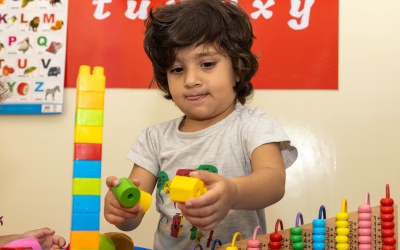
Language is not merely about learning letters. It’s a complex, living skill, communication, conversation, comprehension, vocabulary, and emotional expression, all woven together. Day-care centers are often where so much of this tapestry is woven.
Let’s examine what the data says, explore what works, and see how day care settings contribute far beyond just teaching kids their ABCs.
The Data Speaks: What Research Finds
- Language Isolation in Child Care
According to a study by LENA (Language Environment Analysis), about 1 in 5 children in childcare spend most of their day in language isolation, meaning very few conversational turns with teachers or caregivers. That’s alarming because conversational “serve-and-return” turns are strongly linked with improved vocabulary, social skills, and executive functioning.
- Activity Types & Language Exposure
Research shows that structured activities like story time or circle time would lead to significantly more verbal interaction compared to unstructured play. In one of the studies, about 28% of the daycare classroom time was structured, and the rest was unstructured. Yet conversational interactions with adults during structured times showed a stronger correlation with language gains.
- Teacher Input & Peer Output
A pilot study of classrooms for children with developmental delays found that those children who received more language input from teachers had more positive teacher-child interactions. Also, children who were more talkative themselves (higher language output) showed more positive peer interactions. This suggests that both hearing language and using it are crucial.
- Vocabulary Growth through Balanced Exposure
In multilingual settings (like daycare + home environments), studies find that children exposed to a second language in a balanced way show 20% larger vocabularies and about 15% better grammatical accuracy compared to peers with less exposure. These are meaningful improvements, not just small bumps.
Real-Life Scenes: More Than Just Numbers
To understand how this translates into daily life, here are a few snapshots:
- Scene A: Little Priya, age 2, used to say only “mama,” “dada,” and maybe “ball.” When Priya joined a quality day care like Feather Touch, teachers read stories every day and encouraged kids to ask questions about what they saw. Within six months, Priya was saying full “Where is the ball?” sentences. This enabled her vocabulary to leap forward.
- Scene B: In another center, teachers noticed one child, Arjun, was quieter than his peers. They didn’t force him to talk initially; instead, they paired him with another talkative peer during playtime, telling stories together. Over weeks, Arjun began to mimic longer sentences and even initiated conversations.
- Scene C: A day care program introduced at Feathertouch is “conversational pause” time during meals, teachers would ask something and wait instead of filling the silence. After some time, children used those pauses to speak up, ask questions, and make comments.
These real-life scenes reflect what the data backs up: hearing language + using language = growth.
Why Day Care Matters Beyond the Basics
Beyond ABCs, here are what day care settings uniquely provide:
- Multiple Conversational Sources: Kids hear from teachers, peers, aids, and various caregivers, a rich diversity of speech styles and roles.
- Frequent Serve-and-Return Interactions: Back-and-forth conversation builds not just vocabulary, but reasoning, confidence, and social awareness.
- Opportunities for Risk in Speaking: Children feel safe to try and to make mistakes, because the environment is meant for learning.
- Language as Social Glue: Sharing feelings, asking questions, and discussing conflicts, all these help the emotional development and social skills, not just language.
Strategies That Work
From data + practice, these approaches are most effective:
- Structured Story and Conversation Times
Use circle times or read-aloud sessions where children are encouraged to respond, predict, or question.
- Encouraging Peer Conversations
Group children for play that fosters talk: pretend play, role-play, and group games.
- Training Caregivers for Quality Interaction
Coaches like LENA Grow show that with support, caregivers can reduce language isolation and improve interactive language exposure.
- Balanced Multilingual Exposure
If children are from bilingual or multilingual homes, integrate both languages meaningfully rather than suppressing one. The data shows children have better vocabulary/grammar when both are nurtured.
- Encouraging Child Output
Provide safe moments for children to speak. Encourage their attempts and praise their efforts, and resist your urge to correct theṃ.
Quick Comparison Table
| Factor | Best Practice Setting | Common Low Exposure Outcome |
| Teacher-Child conversational turns | Frequent story times + responsive interaction | Children hear few words, few chances to respond |
| Peer interaction opportunities | Group play, shared storytelling | Silent play or passive observation |
| Structured vs Unstructured time | Mix both, with mental stimulation in structured time | Mostly unstructured, less rich language input |
| Multilingual exposure | Balanced, respectful inclusion of all languages | One language dominates; others are neglected. |
Final Reflections: Why It’s More Than Just ABCs?
Language development in day care isn’t just about letters or phonics. It’s about connection, confidence, and identity. It’s the early ingredient in social skills, emotional health, thinking, and learning.
If we focus only on “when will my child master ABC,” we miss the bigger picture: how many conversations? How many chances to speak, to be heard, to try? Most importantly, in those conversational turns, children not only just pick up vocabulary but also pick up confidence, curiosity, connection, and much more than knowing the ABCs, which sets them up for a life of learning.